Developing Basic Digital
Skills

“We
cannot teach what we do not know.”
As
teachers we must be equipped in terms of technology that are available that can
be used to aid the teaching-learning process. We must be abled enough to
address the needs of this generation, the generation of technology learners.
Teachers
adjust their teaching to effectively match the new digital world of information
and communication technology they must on what basic knowledge and values need
to develop by digital learners.
These
basic literacies will not replace the 3 R’S but they will be complemented by
six essential skills to equip students they call them literacy skills referred
to fluency skills these are:
1. Solution
fluency – refer to capacity and creativity in problem solving.
2. Information
fluency –involves 3 submits skills which is ability to access, retrieve and
reflect information.
3. Collaboration
fluency – refers to teamwork with virtual or real partners in online
environment.
4. Media
fluency – refers to channel of mass communication.
5.Creativity
fluency - which is artistic proficiency adds meaning by way of design, art
and storytelling to package a message.
6. Digital
ethics – is guided by principles of leadership, global responsibility,
environmental awareness, global citizenship and personal accountability.
Bloom’s
Taxonomy serves as a general framework of skills that requires information
processing, idea creation and real-world problem-solving skills. The following
taxonomy may be proposed:
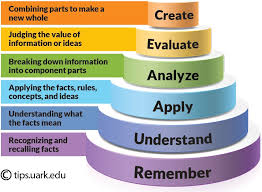
1.
Remembering recall information
2.
Understanding-explain ideas
3.
Applying-use information in a new way
4.
Analyzing-distinguish different parts
5.
Evaluating-justify stand or position
6.
Creating-new product/point of view
The
structured problem solving-process known as 4D’s also exemplifies the
instructional shift in digital learning:
•
Define the problem
•
Design the solution
• Do
the work
•
Debrief on the outcome

Walang komento:
Mag-post ng isang Komento